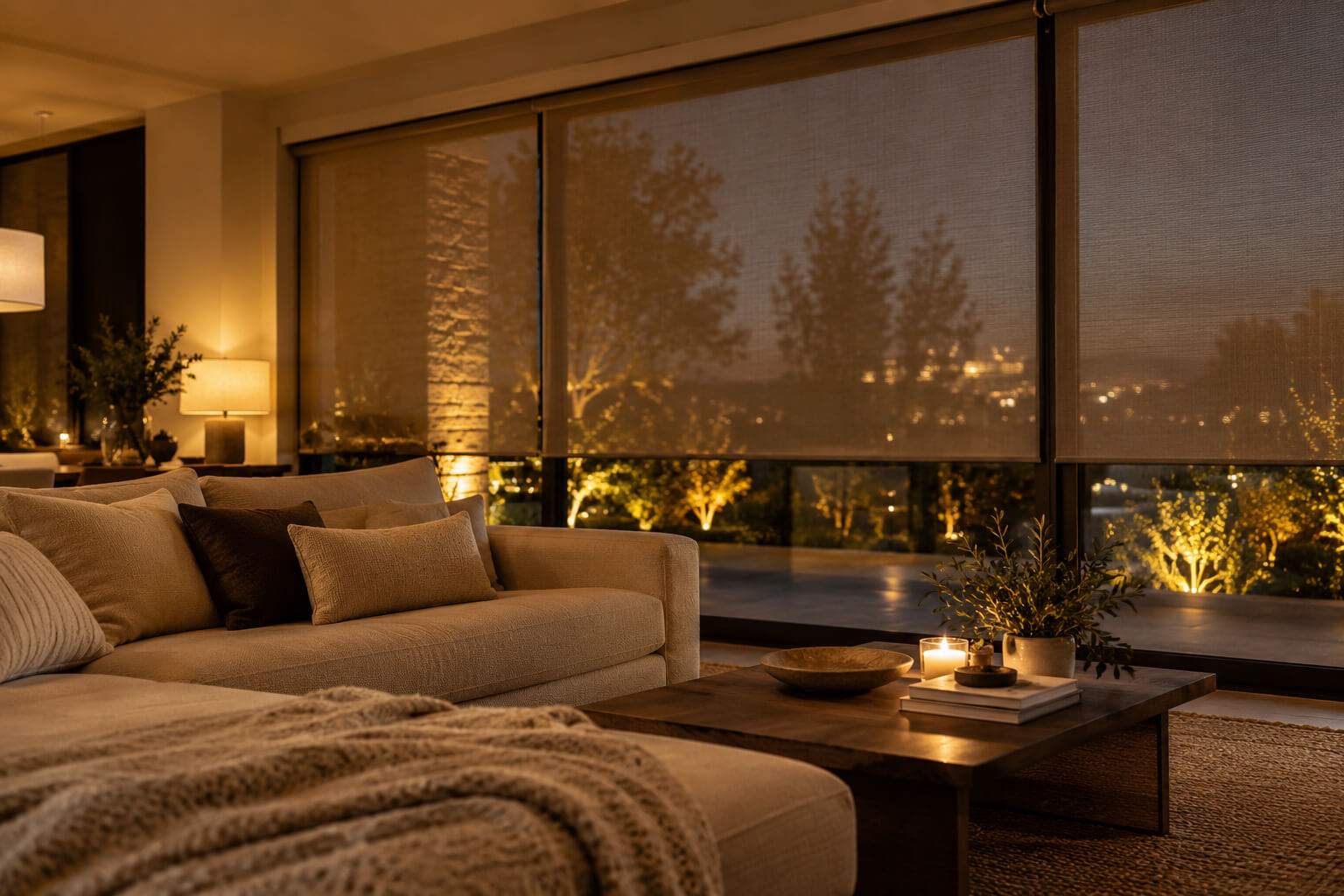
Quick Answer: Do Sun Shades Provide Privacy at Night?
Solar shades generally do not provide complete nighttime privacy when the lights are on inside. Their woven fabric is designed to filter sunlight and preserve outward views, not create an opaque barrier. A tighter weave may reduce visibility, but silhouettes, movement, and illuminated interiors can still be visible from outside. For stronger privacy after dark, consider an opaque roller shade, a room-darkening shade, or a layered window covering.
Key Takeaways
- Solar shades control glare, UV exposure, and solar heat most effectively during the day.
- Interior lighting can make rooms visible through solar screen fabric at night.
- A lower openness factor provides greater coverage but does not necessarily create complete privacy.
- Roller shades made with opaque or room-darkening fabric offer stronger nighttime coverage.
- Custom sizing and professional installation help minimize gaps around a window.
- Motorized shades make it easier to adjust window coverings at sunset or on a preset schedule.
- Different rooms may require different combinations of light control, privacy, and outdoor visibility.
Solar shades are best known for controlling sunlight, glare, and heat during the day, but their performance changes after sunset. The most important difference is privacy. During daylight hours, solar screen fabric can make it easier to see outside while limiting visibility into the home. At night, interior lighting can reverse that effect, allowing people outside to see through the fabric more easily.
Understanding what to expect from sun shades at night can help you choose the right openness, fabric, and complementary window treatment for each room. Solar shades may be an excellent fit for living areas where maintaining an outdoor view is important, while room-darkening roller shades or other opaque options may be more suitable for bedrooms and private spaces.
Sun Shades at Night: Why Visibility Changes
Solar shades use woven screen fabric to reduce the amount of direct sunlight entering a room. Small openings in the material allow filtered light and outdoor views to remain visible, so the shade works on a directional light principle rather than as an opaque barrier. During the day, the exterior is usually brighter than the interior, so the shade helps reduce the ability to see into the home.
At night, the lighting balance changes. Once the interior is brighter than the area outside, the view through the shade may reverse, and solar shades still allow visibility from outside and from inside; what changes is which side is brighter. A person standing outdoors may be able to see illuminated parts of the room, including occupants and their silhouettes. Meanwhile, someone inside may see reflections on the shade or window instead of a clear nighttime view.
This effect is not a defect in the window covering. It is a natural result of woven solar fabric and the contrast between indoor and outdoor light. Nighttime visibility depends on the brightness difference between indoors and outdoors, with each bit of light through the weave contributing to what can be seen. Homeowners should therefore avoid treating solar screen shades as their only privacy solution in bedrooms, bathrooms, or other sensitive spaces.
The fabric’s openness factor also affects performance. Solar shade fabrics commonly fall within a range of approximately 1% to 10% openness. A low-openness fabric has a tighter weave, which provides greater glare control and more visual coverage; for example, a 1% openness fabric can blur details but does not block visibility at night. A higher openness factor preserves a clearer outdoor view but allows more light and visibility through the fabric.
Color makes a difference as well. Darker fabrics often provide clearer outward views because the eye can look through the dark mesh more easily. Lighter colors can reflect more sunlight and may brighten the room, although their daytime views may appear less defined. Fabric color affects how sharp the view appears, not whether the shade provides privacy at night.
Homeowners comparing these options can explore Hartley Window Coverings’ custom roller and solar screen shades for different levels of glare reduction, light control, and style.
How Window Sun Shades Work Throughout the Day
Window sun shades help manage changing light conditions throughout the day while adding privacy, comfort, and protection for your interiors. In Sonoma County homes, the right shade can reduce harsh sunlight, control glare, and make rooms more comfortable without sacrificing style or outdoor views.
During peak daylight hours, solar shades are especially useful for windows that receive strong sun exposure. They can filter UV rays, reduce glare on televisions and computer screens, and help protect flooring, furniture, and artwork from fading. Different openness levels allow you to balance outward visibility with the amount of light and privacy you want.
As daylight fades, your needs may change. A solar shade that preserves daytime views may provide less privacy after dark when interior lights are on. In the evening, they can still diffuse streetlights and other artificial light in living spaces to reduce glare. Bedrooms, bathrooms, and street-facing rooms may benefit from more opaque window shades or layered treatments designed for greater nighttime privacy and light control.
The best choice depends on the room, window orientation, and how you use the space. A family room facing the afternoon sun may benefit from solar shades that reduce heat and glare while maintaining the view. A bedroom may need room-darkening or blackout shades because solar shades filter light but do not fully darken a room or create a practical sleep-friendly setting.
Hartley Window Coverings offers custom interior window shades for Sonoma County homes, with options for solar control, privacy, room darkening, and motorization. Schedule an in-home consultation to compare materials, opacity levels, and styles and choose the right shades for each room.
A Fashion Statement With Practical Reasons and a Functional Purpose
Interior window shades can be an important part of a room’s overall design. The right style can complement furniture, flooring, wall colors, and architectural details while also improving privacy, light control, and everyday comfort. Hartley Window Coverings helps Sonoma County homeowners choose custom shades that look intentional and perform well in each space.
Roller and solar shades are especially popular in modern interiors because their clean lines create a streamlined appearance without overwhelming the window. Homeowners can customize fabric, color, texture, opacity, and operating style to coordinate with the rest of the room. When raised, these shades maintain a low-profile look. When lowered, they become a visible design feature while helping manage sunlight and glare.
Motorized operation adds another level of convenience. Homeowners can control compatible shades using available remotes, wall controls, or automation options instead of adjusting each window manually. Some systems can be set with a motorized blackout layer that closes automatically at sunset. Motorization can be particularly useful for large windows, hard-to-reach openings, and rooms with several shades that need to operate together.
Automated shades can also help manage privacy as daylight changes. Shades can be scheduled to lower as evening approaches, helping reduce visibility into the home once interior lights are on. Hartley Window Coverings can help you compare shade styles, fabrics, controls, and motorization options to find the right combination of design and function for your Sonoma County home.
The U.S. Department of Energy’s guidance on energy-efficient window coverings also explains how properly managed window attachments can help control solar heat gain and improve household comfort.
How Lighting Conditions Affect Privacy After the Sun Sets
The amount of privacy a shade provides depends heavily on the difference between indoor and outdoor lighting. During the day, sunlight outside is usually stronger than the light inside, which can make solar screen fabric appear more private from the exterior while still allowing occupants to enjoy an outward view. After sunset, that balance changes as lamps, ceiling fixtures, and other interior lights become the brighter source, which means lighting contrast directly affects how much privacy the shade provides at night.
This shift is especially important for rooms that face sidewalks, neighboring homes, driveways, patios, or other areas where people may be nearby after dark. A solar shade with a tighter weave can provide more visual coverage than a higher-openness fabric, but it still may not create the level of privacy a homeowner expects once the room is illuminated. Solar shades provide only limited nighttime privacy because the fabric remains transparent under interior lighting. The fabric, color, openness factor, window size, and surrounding light conditions all influence the final result.
For rooms where privacy is a priority at night, homeowners may want to pair solar shades with a more opaque treatment or choose a room-darkening option instead. Hartley Window Coverings can help compare fabrics and shade styles in the space so the selected treatment supports both daytime light control and nighttime privacy. Turning off interior lights can restore privacy because it reduces the indoor-outdoor contrast. Reviewing samples at different times of day can also make it easier to understand how each material will perform before placing an order.
Choosing the Right Shades for Nighttime Privacy
The best choice depends on how the room is used. Solar shades work particularly well in spaces where glare reduction and daytime views are priorities. Their woven construction filters light without creating the fully enclosed appearance of opaque fabric. On their own, they are not a good match for bedrooms where nighttime privacy matters.
If nighttime privacy is more important, an opaque roller shade may be a better choice. Roller shades are available in a variety of fabrics, including light-filtering and room-darkening selections. Blackout or room-darkening shades are more effective for nighttime privacy than solar shades. Room-darkening material blocks significantly more light and limits visibility through the shade, although small amounts of light may remain around the edges of the installation.
It is important to understand that “blackout” usually describes the material rather than the entire installed window covering. Even opaque material may allow light around the sides unless the overall design addresses those gaps. A low-openness solar fabric will not make a room fully black at night. Custom measuring and professional installation can improve coverage, but the result will still depend on the window, mounting style, and selected product.
An outside-mounted shade can extend beyond the window opening and may reduce the edge gaps associated with some inside-mounted installations. The best mounting approach depends on the available wall space, trim, window depth, and desired appearance.
Hartley also offers cellular honeycomb shades, which use structured fabric cells that trap air and provide added insulation. Room-darkening fabric choices can make cellular honeycomb shades useful for bedrooms, media rooms, and other spaces where privacy, comfort, and reduced incoming light are priorities. Dual shades combine a light-filtering layer with a blackout layer for added privacy and control.
In some rooms, layering window treatments provides greater flexibility. A solar shade can control daytime glare and preserve the view, while curtains or another opaque window treatment can improve privacy when it is dark outside. The ideal arrangement should fit the room without making daily operation unnecessarily complicated.
Sun Shades at Night: What Should Homeowners Remember?
Sun shades at night are about changing light conditions and privacy. A solar screen that appears private during the day can become more transparent when the lights are on inside, so homeowners should consider how the room is used before selecting a fabric.
Before selecting a fabric, consider the following questions:
- Is daytime glare reduction or nighttime privacy the main priority (standard solar shades are graded by openness percentages)?
- Does the window face a street, walkway, or neighboring property?
- Is preserving the outdoor view important?
- Will the shade be used in a bedroom, bathroom, living area, or workspace?
- Would room-darkening material be more appropriate?
- Could motorization make daily adjustment easier?
- Should the shade be mounted outside the window opening for additional coverage?
Viewing fabric samples under different lighting conditions can also help. A good next step is to compare samples in the actual room rather than relying on showroom lighting alone. For example, even a 1% openness sample should not be expected to block all visibility at night. Professional guidance makes it easier to compare openness, color, privacy, and light control before ordering.
Find the Right Balance of Daytime Views and Nighttime Privacy
Solar shades can reduce daytime glare, manage sunlight, and preserve outdoor views, but they should not be relied upon for complete privacy after dark. Hartley Window Coverings can help you compare solar, roller, cellular, and room-darkening options for the way each room is used.
Schedule a consultation with Hartley Window Coverings to find a custom window treatment that delivers the right combination of light control, privacy, comfort, and style.
Frequently Asked Questions
Can people see through solar shades at night?
Yes, they often can when the room is illuminated. Because solar shades use woven fabric, people outside may see silhouettes, movement, or details inside when the interior is brighter than the exterior.
Do lower-openness solar shades provide nighttime privacy?
A lower openness factor provides more coverage than a higher openness factor, but it should not be assumed to provide complete nighttime privacy. Opaque or room-darkening materials are more appropriate when privacy is essential.
Do solar shades block outside lights at night?
Solar shades can soften streetlights, headlights, and other exterior lighting, but standard solar screen fabric does not block all artificial light. The amount filtered depends on the fabric’s weave, color, and openness.
Are blackout and room-darkening shades the same?
Not necessarily. Room-darkening shades reduce most incoming light, while blackout fabric is designed to block light through the material. However, an installation using blackout material may still have light gaps around its edges.
Can solar shades be motorized?
Compatible roller and solar shades can be configured with motorized operating options. Motorization may allow shades to be adjusted by a control system, remote, or other supported interface, depending on the selected product.


.webp)